Is It Better to Save or Invest Right Now? A Real-Numbers Comparison
You've got $10,000 sitting in your checking account. Maybe it's a tax refund, an inheritance, or months of disciplined budgeting. Now comes the question everyone faces: should you park it in a high-yield savings account where it's safe, or invest it in the stock market where it could grow — or shrink?
The internet is full of vague advice: "it depends on your goals." That's technically true but practically useless. What you need are real numbers, clear timelines, and honest trade-offs. That's exactly what this guide delivers.
We'll compare saving versus investing across multiple timeframes and scenarios using today's actual rates, so you can make a confident decision with your money.
For money you'll need within 1–3 years, save it — a high-yield savings account at 4–5% keeps it safe and accessible. For money you won't touch for 5+ years, invest it — index funds have historically returned 7–10% annually and dramatically outperform savings over time. For the 3–5 year range, consider splitting between both.

The Current Landscape: Savings Rates vs Market Returns
Right now, high-yield savings accounts offer 4–5% APY. That's genuinely good — historically, savings rates hovered around 0.5–1% for over a decade. So saving has rarely been this attractive.
Meanwhile, the S&P 500 has averaged about 10% annual returns before inflation (roughly 7% after) over the past 30 years. But those returns are anything but smooth. In 2022, the market dropped 19%. In 2023, it surged 24%. In any given year, stocks can go up 30% or down 30%.
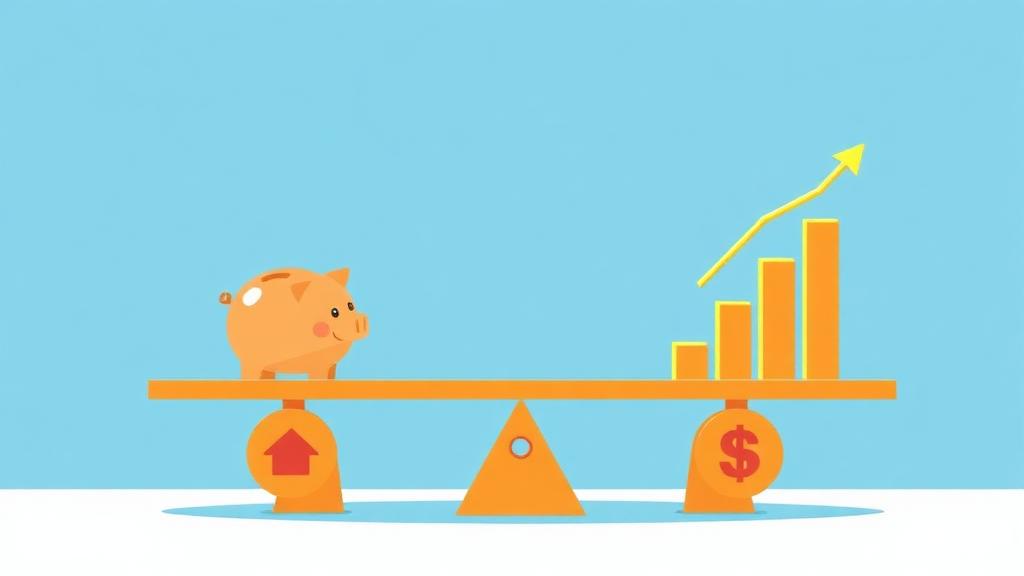
This volatility is the core trade-off. Savings give you certainty: you know exactly what you'll earn. Investing gives you higher expected returns but with real risk of short-term losses.
$10,000 Over 3 Years: Saving Wins
Let's put $10,000 into both strategies and compare after 3 years.
High-yield savings at 4.5%:
- Year 1: $10,450
- Year 2: $10,920
- Year 3: $11,412
You earned $1,412 with zero risk. Your money was accessible the entire time. No sleepless nights.
S&P 500 index fund at 10% average:
- Best case (steady 10%): $13,310
- Realistic case (with a bad year): could range from $9,000 to $14,000
- Worst case (bear market): below $8,000
The expected return is higher, but you could easily end up with less than you started. Over just 3 years, the market doesn't have enough time to recover from a downturn. For short-term money, the savings account is the smarter choice.
$10,000 Over 10 Years: Investing Pulls Ahead
Now let's stretch the timeline to 10 years. This is where things get interesting.
High-yield savings at 4.5%: $15,530
Solid growth. But remember — savings rates change. Today's 4.5% could drop to 2% if central banks cut rates. A more realistic average over a decade might be 3%, giving you about $13,440.
Index fund at 7% (inflation-adjusted): $19,672
Even using the conservative inflation-adjusted number, investing beats saving by $4,000–$6,000 over a decade. At the nominal 10% average, you'd have $25,937 — more than double your savings account balance.
The key insight: over 10 years, the stock market has never produced a negative return in U.S. history. The longer your timeline, the more investing dominates. Use our compound interest calculator to model your exact scenario.
$10,000 Over 20 and 30 Years: The Gap Becomes Massive
This is where the comparison becomes dramatic.
20 years:
- Savings (3% avg): $18,061
- Investing (7%): $38,697
- Investing (10%): $67,275
30 years:
- Savings (3% avg): $24,273
- Investing (7%): $76,123
- Investing (10%): $174,494
After 30 years, the investor has 3× to 7× more money than the saver. The saver's $10,000 grew to $24K. The investor's grew to $76K–$174K. Same starting amount. Same monthly effort (zero). The only difference was where the money sat.
This is the power of compound interest at higher rates. Even a few percentage points create enormous gaps over decades.
Same deposit, zero extra contributions. The only variable is where the money sat.
When Saving Is the Right Choice
Saving isn't just for the risk-averse. There are real situations where it's objectively the best strategy:
- Emergency fund: You need 3–6 months of expenses in an easily accessible account. This is non-negotiable, regardless of market conditions.
- Short-term goals (under 3 years): Buying a car, wedding, home down payment — anything you'll need soon should stay in savings.
- High-interest debt: If you're paying 15–25% on credit cards, "saving" by paying off debt gives you a guaranteed 15–25% return. That beats any investment.
- Market uncertainty with near-term needs: If you need the money in 2–4 years and a 20% drop would derail your plans, save it.
- Peace of mind: If market volatility would cause you to panic-sell, you're better off in savings. The worst investing strategy is buying high and selling low out of fear.
When Investing Is the Right Choice
Investing wins when time is on your side:
- Retirement savings: If you're 10+ years from retirement, investing in diversified index funds is almost always the better play.
- Long-term wealth building: Money you don't need for 5+ years should be working harder than a savings account allows.
- After your emergency fund is full: Once you have 3–6 months saved, additional cash should go to investments.
- Employer match: If your employer matches 401(k) contributions, invest at least enough to get the full match. That's a 50–100% instant return — nothing else comes close.
- Inflation protection: Over long periods, savings rates often fail to keep pace with inflation. Investing provides real purchasing power growth.
See how different contribution amounts and rates play out with our investment growth calculator.
The Smartest Strategy: Do Both
The save-or-invest question creates a false choice. Most people should do both, but in a specific order:
- Build your emergency fund first. Save 3–6 months of expenses in a high-yield savings account. This is your foundation.
- Pay off high-interest debt. Anything above 6–7% interest should be eliminated before investing.
- Get your employer match. Contribute enough to your 401(k) to capture the full employer match.
- Invest everything else for long-term goals. Open a brokerage account or max out your IRA with low-cost index funds.
- Keep short-term money in savings. Any money you'll need within 1–3 years stays in your high-yield savings account.
This layered approach gives you the safety of savings where you need it and the growth of investing where you can afford to wait. It's not either/or — it's both, strategically.
A Real-Life Example: Sarah's $30,000 Decision
Sarah is 28 with $30,000 in her checking account. She wants to buy a house in 3 years and retire by 60. Here's a smart split:
- $10,000 → High-yield savings (emergency fund)
- $10,000 → High-yield savings (house down payment in 3 years)
- $10,000 → Index fund (retirement in 32 years)
After 3 years, her savings accounts hold about $22,000. She uses $10K for the house and keeps the rest as her emergency fund. Meanwhile, her $10,000 investment — untouched for 32 years at 7% — grows to approximately $87,000. If she adds just $200/month to her investments, she'll have over $350,000 by retirement from that stream alone.
Calculate your own split with our savings calculator and compound interest calculator.
Key Takeaways
- Under 3 years: save. High-yield savings accounts at 4–5% give you safety and certainty.
- Over 5 years: invest. Index funds historically outperform savings by 2–3× or more over long periods.
- 3–5 years: split it. Keep some safe, invest some for growth.
- Emergency fund always comes first. 3–6 months of expenses in savings, no exceptions.
- The real enemy is doing nothing. Money in a checking account earning 0.01% loses to inflation every single year.
- Time is the deciding factor. The longer your horizon, the more investing wins. The shorter, the more saving wins.
Find Your Perfect Balance
Everyone's situation is different. Use our compound interest calculator to see what investing could do for your long-term money. Then use the savings calculator to plan your short-term goals. The right answer isn't save or invest — it's knowing how much to put where.
Frequently Asked Questions
The Bottom Line
The save vs invest debate has a simple resolution: it's a question of when, not which. Short-term money belongs in savings. Long-term money belongs in investments. The mistake isn't choosing the wrong one — it's leaving money idle in a checking account earning nothing, or investing money you'll need next year. Know your timelines, fund your priorities in order, and let each dollar work in the place where it does the most good. The numbers don't lie: over time, the investor always wins. But the saver sleeps better tonight. Build a plan that gives you both.
Found this useful?
Share it with someone who should start investing today.